
March 21, 2026 12:51
 Amaplast, the association representing Italian manufacturers of machinery and equipment for the plastics and rubber industry, has released the sector’s 2025 results, partially revising the preliminary figures issued at year-end (read article).
The 5% decline in sector output compared with 2024 was confirmed, bringing production to €4.4 billion, while the contraction in exports was revised to 5% from the 6% estimated on the basis of the first nine months of 2025.
By contrast, growth in imports of plastics and rubber machinery into Italy was revised upwards from the preliminary estimate of 16% to 24%, driven by what Amaplast describes as “a rather buoyant domestic demand, evidently also attributable to the effect of the incentives introduced under the 4.0 and 5.0 Italian incentive plans, despite the difficulties in accessing them and the delays in the issuance of the various implementing decrees”.
As a result, the trade surplus narrowed significantly, although it remained positive: after the record €2.65 billion reached in 2024, it fell to €2.24 billion last year.
A number of negative factors weighed on exports: uncertainty caused by the introduction of US tariffs, the depreciation of the dollar against the euro and, more recently, the worsening conflict in the Middle East, which raises more than one question mark over the sector’s sales performance in 2026.
"The energy crisis has already begun to hit the European converting industry hard, with rising prices for gas, oil and plastic raw materials, as well as major uncertainty over material availability,” the Amaplast Research Centre said in its statement.
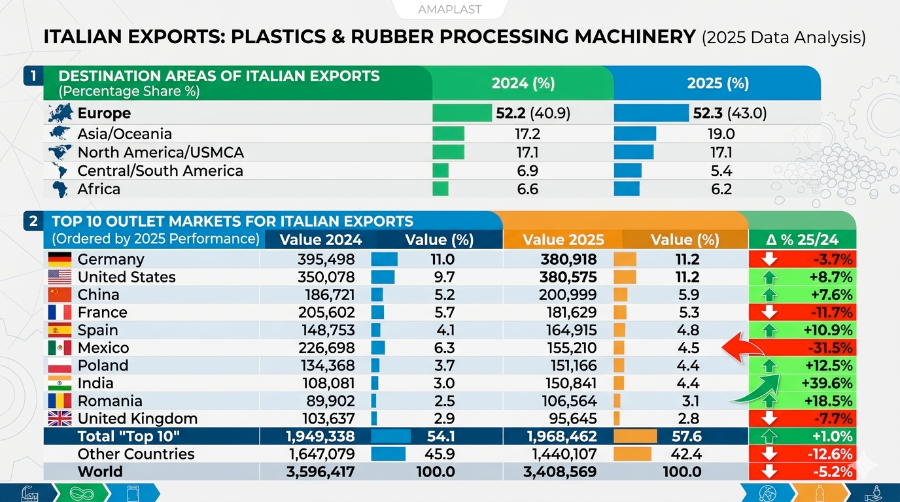 Germany, Italy’s leading trading partner, was the main factor behind the negative trend in European exports, posting a second consecutive decline that does not bode well. Supplies to French converters, another key EU destination, also fell. Helping to offset the picture were higher deliveries to Spain, Poland and Romania.
The Trump administration’s tariffs do not appear to have affected sales of Made in Italy machinery in the United States, which in 2025 actually rose by almost nine percentage points. This trend is also confirmed by data from the Plastics association on shipments of primary plastics processing machinery to the US market, which grew by 7% last year.
Sales also continued to rise in China and, above all, in India, where they have more than tripled over the past decade, driven by the Make in India programme. “This is a market with considerable potential that still remains largely untapped, also thanks to the recently signed free trade agreement,” Amaplast said.
From a product perspective, exports of extruders fell from €400 million to €350 million, sales of blow moulding machines declined from €212 million to €198 million, and mould sales dropped from €752 million to €721 million, while injection moulding machines posted slight growth, rising from €194 million to €199 million.
Given the geopolitical backdrop, any forecast for the current year is about as reliable as a roll of the dice. “There are too many unknowns, overlapping one another at international level and worsening the climate of uncertainty in which companies are operating, with many of their traditional destination markets presenting access difficulties.”
© Polimerica - Reproduction prohibited, all rights reserved

